BLACK HOLES / PHASE / INFORMATION
The Magic
Phone.
A phase-lock hypothesis for
black-hole information.
01 / THE IDEA
What happens to the call?
The Magic Phone began as an image: an overloaded switchboard where nobody can hang up.
Every incoming call adds something to the system. Every connection changes the conditions for the next one. The hypothesis asks how a record of those events might remain accounted for while its outward expression becomes fragmented and difficult to read. [1]
In the paper’s language, the horizon becomes a boundary ledger. Interacting phases form locks and constraints. A proposed “LuxG” route permits compatible fragments to become outward-readable, and each release changes the lock that follows.
A call arrives.
An incoming unit adds energy, angular momentum, and a record to the model.
The switchboard changes.
Interacting phases can align, oppose, lock, and unlock. Closed loops contribute further constraints.
A fragment gets through.
A release transfers a unit to the radiation ledger. The next candidate encounters an updated system.
The question being developed: can these effective rules produce useful, distinguishable behavior—and can that behavior eventually be connected to a measurable black-hole signal?
02 / THINKING ON PAPER
Read the hypothesis.
The original essay follows the metaphor from an impossible buffet and an overloaded receiver to interlocking rings, boundary accounting, and phase-dependent release. The mathematical workbench below gives a subset of those ideas explicit rules.
THE ORIGINAL ESSAY · 5 PAGES
The Magic Phone, the Interlocking Rings,
and the Forward Motion of the Dark
Presented as supplied, with its wording intact.
03 / UNDER THE COVER
From a metaphor to rules.
Magic Phone Phase-Lock Simulator — Audited v1.1 is an executable toy model. Its source makes the proposed dynamics and accounting inspectable. [2]
Complex phase states
Each effective ring carries a two-component complex state, energy, angular momentum, a radius, and handedness.
Locks that can change
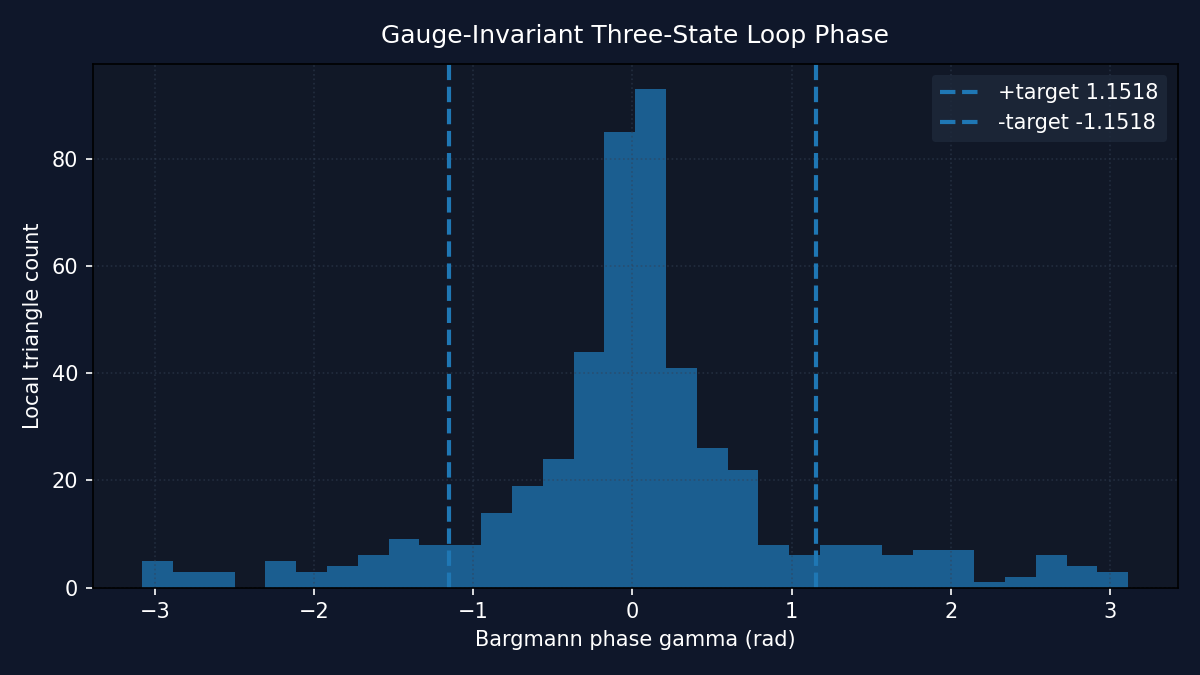
Oscillator-style phase dynamics and an interaction graph determine opposition and locking. Three-state loops have a signed, gauge-invariant phase diagnostic.
A bill that balances
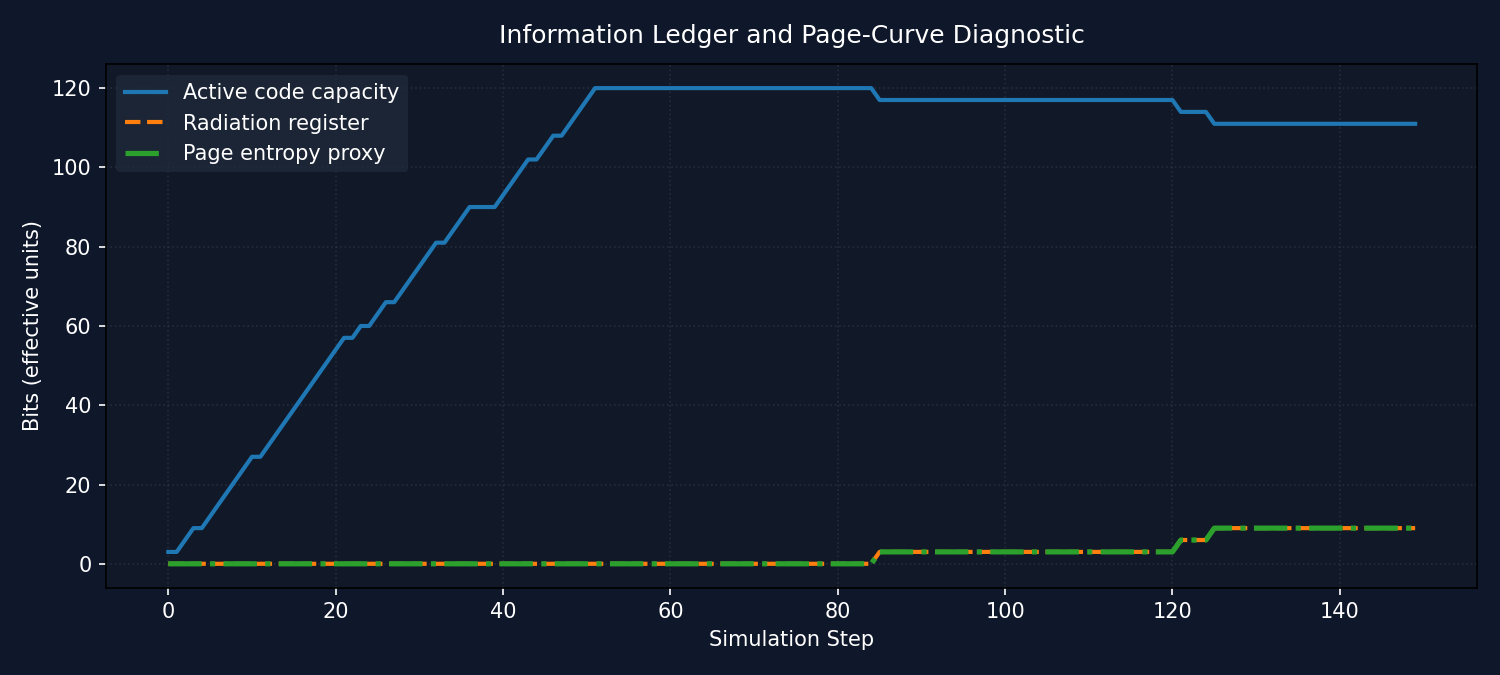
Releasing a complete unit removes it from the active ledger and transfers its assigned code bits to the radiation register.
The release rule is an assumption.
The chosen emission hazard has an inverse-mass-squared baseline, modified by LuxG phase alignment and constraint burden. The gate, coefficients, and link from model states to black-hole physics remain parts of the proposal. The code does not derive Hawking radiation or solve a black-hole spacetime.
The package includes Python source, tests, a local web interface, and the recorded outputs. Running the simulator requires a local Python environment; the installation instructions are in the README.
04 / ONE RECORDED RUN
What the supplied run did.
These figures and data come directly from the demonstration bundled with v1.1. They show one outcome of its chosen rules. [3]
- Units admitted
- 40
- Units released
- 3
- Units remaining
- 37
- Recorded steps
- 150
120 input bits=111 active bits+9 radiation bits
The model assigns three bookkeeping bits to each unit. At the final recorded step, 13 of the 37 remaining units are locked. The maximum absolute information-balance error in the CSV is zero.
Run settings & reproducibility
- Random seed
- 42
- Recorded indices
- 0–149
- Configured accretion limit
- 60 steps
- Population cap
- 40 units
- Phase drift rate
- 0.08 rad/step
- Phase-match tolerance
- 0.15 rad
- Release-hazard scale
- 100
- Recorded release steps
- 85, 121, 125 (zero-based)
The 40-unit cap is reached before the configured accretion limit; the CSV’s accretion flag first becomes false at step 52. Figures below are the original output files.
python run_demo.py --seed 42 --steps 150 --accretion 60 --release-scale 100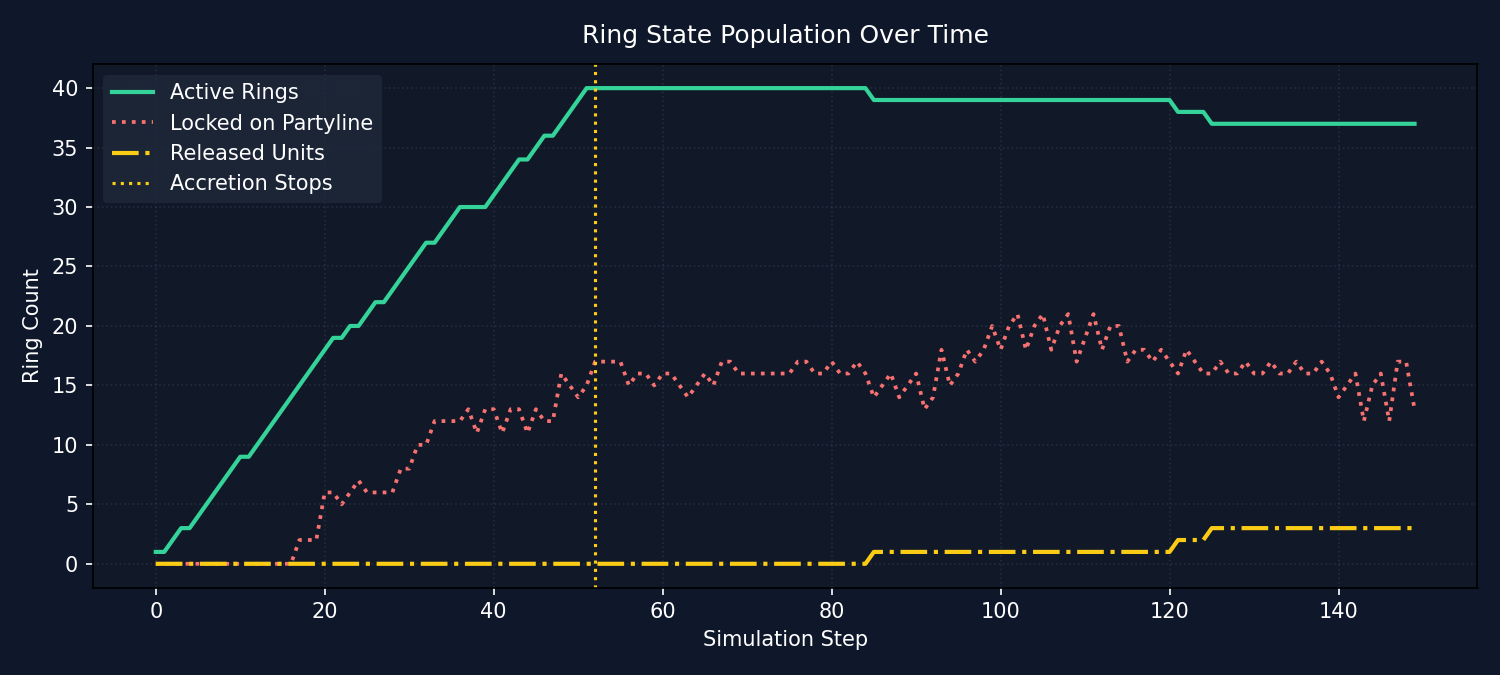
Code review notes for this release
The ten supplied test functions passed when invoked directly during the notebook review. The pytest runner was unavailable in that review environment. These checks exercise the implementation; they do not validate the proposed mechanism against observations.
The interaction graph is local, with additional global influences from the common phase and distance-weighted opposition burden. Constraint diagnostics reuse the pre-release graph, so they can include a just-released unit until the next step; mass and code-bit accounting update with the release.
The source ZIP is published unchanged. Its included audit describes further scientific gates. “Audited v1.1” is the supplied package’s version designation.
05 / STILL ON THE SWITCHBOARD
Useful questions to pick up.
The next tests should tell us which behavior depends on the proposed mechanism and which behavior survives simpler rules. These directions follow the source package’s audit. [4]
Find the mistake. Try the control. Leave the next person a clearer question.
06 / TAKE THE WORK WITH YOU
Files & sources.
The essay, source archive, data, log, and figures are supplied in their original form.
Notebook entry first published 9 November 2026. The figures reproduce the recorded demonstration distributed with the source package. Numerical summaries were checked against its CSV and run log.